



More than 50% of homeowners renovating their home on a significant scale blow their initial renovation budget during the project – 51% to be precise, according to the 2023 Houzz & Home Study – and the reason rarely lies in one particular decision. It is dozens of small mistakes due to the lack of guidance as to where exactly the budget should be spent that determines whether one’s renovation will be a profitable experience or a costly lesson. The renovation splurge vs. save list depends on knowing which room to renovate and which surface to upgrade when one renovates.

Think about what can be splurged on when renovating, not about what looks nice
While the $40 hinge may boast a ball-bearing and a stainless-steel pin, and its brushed finish may resist cleaning chemicals, if one rarely uses the hinges enough to wear out a cheaper alternative, such an upgrade will hardly be worth the cost. Homeowners often feel pressured to choose between the two when it comes to a comprehensive renovation since the more substantial parts of the room (doors and lights) can make the differences between standard and upgraded components less noticeable. However, as long as the doors are properly installed, their regular hinge will perform its job just as well as the European one would. One should rather invest in their lifestyle by choosing the parts that will see regular use, for it is the most worn surfaces that will require renovation the soonest. A well-chosen kitchen faucet that begins to malfunction internally after two years will yield fewer benefits than a more expensive, better-maintained alternative.
Similarly, one should avoid overspending on surfaces that are mainly decorative. No one will notice the pattern of one’s guest bathroom floor. A simple subway tile, well-placed and cleaned, is more likely to hold up to the frequent use of the place while allowing a homeowner to direct the savings towards the main bathroom where the majority of the traffic takes place.
The kitchen renovation budget: where to spend and where to save
The kitchen is the largest expenditure of any comprehensive renovation, both in absolute terms and in terms of percentage. Yet, it is also one of the areas where one should be particularly careful not to throw away money on unnecessary expenses. The most crucial piece of advice for keeping the kitchen renovation costs in check is not to move the plumbing. Any kitchen has its wet wall, i.e., the wall behind the sink where the water supply and sewage pipes are located. One should rather build the rest of the room around it than attempt to relocate it, which would incur substantially higher costs.
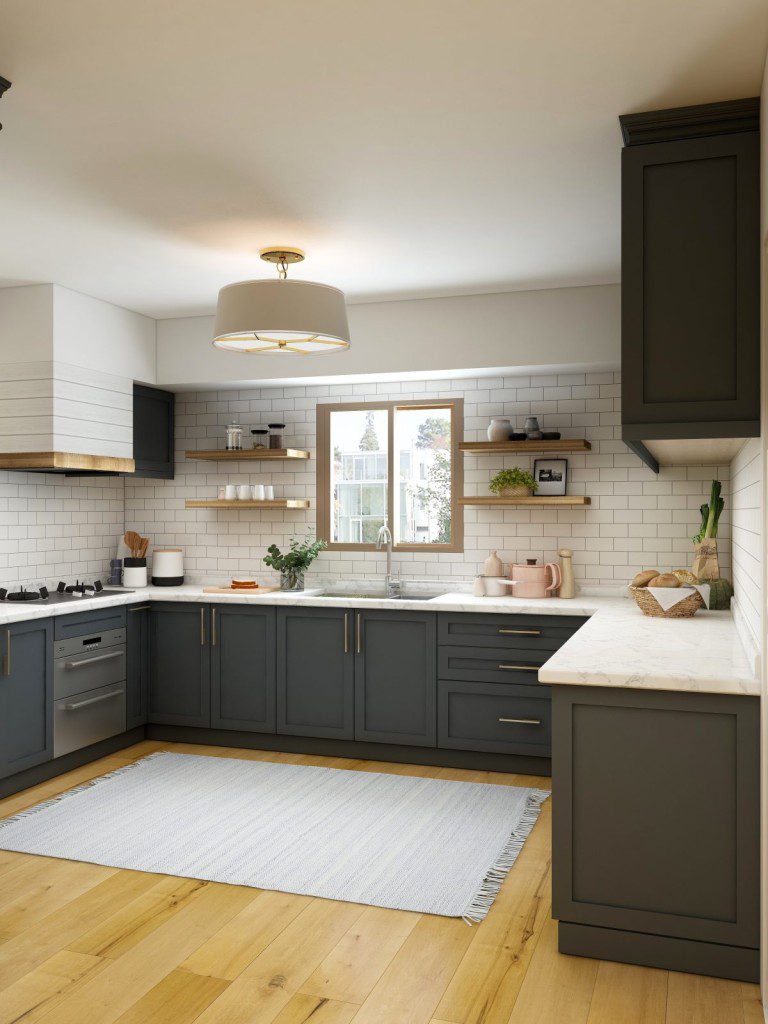
The money saved from not hiring plumbers on the side may be redirected to more impactful expenditures on materials and appliances. When picking out the cabinetry, one should also remember the budget. Although custom cabinets offer a more precise fit, semi-custom alternatives offer a wide variety of modifications for a much lower price. In most cases, they are a better choice for a kitchen renovation as they allow the same end result for a much lower price. The money saved on cabinets may be redirected towards high-quality countertops, which will provide better value than any other upgrade.
The bathroom renovation budget: the good and the less important
When talking about the bathroom, it is a part of any comprehensive renovation where the suggested splurge vs. save list should yield the best results. The best way to approach a bathroom renovation within a limited budget is to pick one’s vanity, be precise with one’s fixtures, and be economical with the tile. One should rather spend on a well-made built-in (or even bought) vanity or a custom one within the budget. This way, one gains a cabinet that feels like a piece of furniture. It is essential to choose a good mixer that will rarely malfunction or begin dripping after two years. When those two points are covered, one may save money on less important expenditures, such as mirrors and light fixtures, by opting for budget alternatives.
On the tile, one should rather spend on the floor and save on the walls. It is much easier to install large standard tiles with good quality, beautiful results than it is to do the same with subway ones. As long as the floor is clean and installed correctly, it does not need any other finishing touches and will save money on materials as well as labor. Even though it may sound counter-intuitive, a $6 tile, well-placed by a good installer, will look better than a $30 one placed by an amateur. One should remember to calculate the total square meters of tile required when choosing how much to spend as the difference between a $30 per square meter floor and a $20 per square meter wall can be noticeable.
Planning professional services: the designer’s fee
The designer’s fee is one of those costs that many people find themselves thinking of as an addition to their renovation costs. After two months of hard work and several thousand spent on framing, a conversation with a contractor about an overlooked wall structure behind the future bookshelf can make the designer’s role painfully obvious. Most changes made on-site incur heavy costs due to their complexity and the disruption of progress. It is much more efficient to finalize the design before one chooses the materials. When working with a comprehensive service provider such as Veejay’s Renovations, this factor is much less relevant, as the design process is integrated with the general contractor’s work and does not incur any additional costs.
It is essential for one’s budget that, when renovating a whole house, the responsibility for the project’s management always falls on one person and not on a team of independent contractors, as is the case with many design-build agencies. This is primarily due to the fact that it is much easier for one person to coordinate materials, labor, and design than for a team of independent contractors to do so. When working with separate professionals, it is always necessary to contact both the cabinetmaker and the tiler to arrange a mutual work schedule.
Heating, ventilation, and windows: the splurge that will pay for itself
Many homeowners underestimate the long-term value of upgrading their heating and ventilation system and replacing single-pane windows with double or triple ones. While the immediate benefits afforded by $10,000 spent on a high-efficiency HVAC system may seem minuscule in comparison to the costs incurred, it is the slow, almost imperceptible changes that will ensure the homeowner’s lasting satisfaction with their renovation for years to come. In comparison to the $10,000 spent on the system, the benefits reaped from its efficiency may seem modest, but those $10,000 will be spread across the 15-20 years of the system’s lifespan.

A similar case may be made for the windows. Upgrading from single-pane to double-pane windows will reduce heating and air-conditioning costs, eliminate window condensation, and, in general, improve the comfort of the home’s occupants. In addition, one will be able to reclaim several hours from their weekly schedule due to the reduced need for cleaning and maintenance around the windows. Such a renovation addition may not seem as exciting as, say, replacing one’s entire kitchen with a custom one, but it will have a much more significant effect on one’s day-to-day life in the long run.
Staged renovation and the discipline to stick to the plan
It is not necessary to renovate more than one room at a time. In fact, a staged renovation with a clearly defined sequence of stages is the best way to renovate one’s home without breaking one’s budget. In most cases, the renovation should begin with the kitchen and the bathroom, as they both offer the highest reward in terms of both personal enjoyment and potential profit on resale. After that, one may proceed to renovate the living room and the bedroom, leaving the least personally important rooms, such as the guest bedrooms, to the end.
However, one should try their best to adhere to the outlined plan when renovating in stages as there is a tendency to add on more work than one initially intended. This may present itself in the form of a simple kitchen renovation turning into a combined kitchen-laundry room renovation or a bathroom renovation followed by the floor renovation in the hallway. When taken individually, those additions may not seem like a problem, but in aggregate, they may cause one’s renovation to either greatly exceed one’s initial budget and drag on for much longer than anticipated.
It is best to outline the scope of one’s renovation in detail before proceeding to any actual work. This way, if one decides to add on more work, one will understand what one will have to postpone or even cancel. It is unpleasant to have to deny oneself one’s desires, but the additional funding from the postponed luxury renovation will come in handy when one realizes the amount of money one has managed to save from not overextending oneself.
The renovation budget: the hidden costs and the additional funds
When people talk about renovation, they rarely think of alternative accommodations and furniture storage as essential expenditures during the project, but those are some of the most substantial ones. The costs of eating out more frequently due to the kitchen being closed for a while, the costs of being unable to live in one’s home for a period of time, and the additional storage fees for one’s belongings are all much more difficult to bear than one may initially think. That is why it is essential to set aside additional funds for those expenditures. As for the additional costs that arise within the renovation itself, 15 to 20% of the construction cost should be set aside for one’s contingency.
If the contingency fund is not needed, it may be used to improve one’s renovation during the closing stages.
The staged renovation: landing the project you set out to complete
Deciding on a comprehensive renovation is a large step for most homeowners, as it is a sizeable expenditure for anyone and, therefore, should be carefully considered. Most renovators who manage to complete their project with little to no additional costs and who express their satisfaction with the end result tend to remember one crucial detail: the financial planning. They knew before-hand which areas to renovate would bring the most benefits and where one should spend money on premium materials. As a result, they had a realistic estimation of their renovation costs, had an additional fund to fall back on when unexpected events occurred, and were disciplined enough not to spend their contingency on luxury upgrades in the early stages of their project. All things considered, those who understand the renovation splurge vs. save list inside out tend to complete their project within the initially set budget and within their means.